

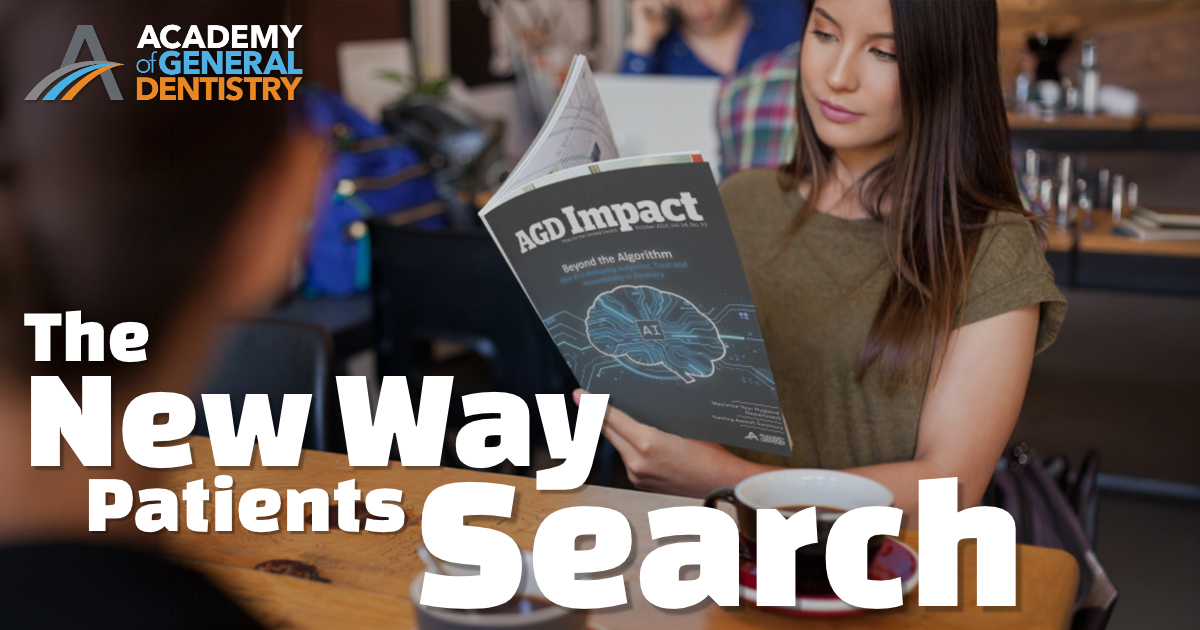
This article originally appeared in the October/2026 issue of the Academy of General Dentistry’s AGD Impact magazine.
Patients Are Finding Dentists Through AI. Is Your Practice Ready?
By: Jackie Ulasewich Cullen
Not long ago, conversations about artificial intelligence in dental marketing felt speculative. Today, they’re becoming part of everyday conversations with dental practices.
More dentists are asking how AI is changing the way patients find healthcare providers. Some are even seeing it firsthand. Prospective patients are beginning to say they found the practice through ChatGPT or another AI assistant rather than a traditional Google search. While those conversations are still relatively new, they’re happening often enough that practices are paying attention.
The question is no longer whether AI will influence how patients search. It’s how practices can position themselves to be found as those search habits continue to evolve.
The good news is that the answer isn’t starting over.
Strong generative engine optimization (GEO) and answer engine optimization (AEO) start with strong search engine optimization (SEO). Currently, AI search engines still rely on traditional search signals and indexes to understand, trust, and recommend businesses. Therefore, dental practices should not view GEO as a replacement for SEO but as an extension of it. The strongest AI visibility comes from building a solid SEO foundation first, then adding strategies that help AI models better understand and reference the practice.
A real-world example is a doctor who told us he hired a fully automated AI marketing agency. The Google ads it produced didn’t accurately represent the practice. Thankfully, he was able to prevent the ads from going live. Although no harm was done, there certainly could have been negative consequences had he not checked the AI’s work. AI is far from perfect, and while using AI provides benefits, it requires some degree of QA.
Does AI Help or Harm Search Results?
AI’s content effects on search results aren’t clear at this moment. There’s not enough data for anyone to accurately predict what may happen as a result of a preponderance of AI-generated website content. Additionally, companies disagree on the potential effects, with some claiming that fully AI-generated website and blog content is perfectly fine and gets cited. Others say there could be ramifications.
What we do know is that more patients are using AI searches every day. Most sources estimate that between 20% and 40% of people use AI in their searches for local healthcare providers, and that this will only grow as more AI tools become available to consumers and as providers incorporate AI into their marketing strategies. For this reason, practices should consider what they are doing for GEO and SEO to ensure they appear in AI searches.
Caveat: AI’s capabilities are always expanding, which means the rules could change quickly as new developments come to market. The strategies that work today may no longer be effective six months from now. It’s important to stay informed and be prepared to adapt to new practices as they arise. Currently, however, this is what seems to be working:
- Answer-first content: Humans read. AI extracts. Content created for human eyes usually builds up to the answer. AI processes content the opposite way. So, for AI to notice online content, it must be structured so that a full, direct answer appears at the beginning. A great example would be an FAQ section on a web page.
- Schema markup: Without getting too technical, a schema markup is code that helps search engines and AI systems understand website content. Having schema markup on a website does more than help AI. It also enables search engines like Google to show enhanced search results, like star ratings.
- NAP consistency: Not a new concept, name, address, and phone number (NAP) consistency means that no matter where the information is displayed on the web, whether it’s a channel the practice owns or a third-party review like Yelp, it’s exactly the same. With GEO and AEO in the mix, it’s even more important.
- Google reviews: At this time, Google reviews remain the top trust signal for AEO. AI engines use them to evaluate a business’s authority, safety, and credibility. The biggest factors AI considers are recency, which indicates the practice is currently active; specificity, because details help AI match the information to a query; and volume, because a larger sample size gives AI more to work with.
- YouTube content: Because it’s one of the oldest and most widely used applications for online video sharing, YouTube is a treasure trove of content that AI can extract. AI search engines favor content that combines facts, engagement, and human context. Video is perfect because it includes structured data (transcripts and captions) and unstructured signals (comments and reactions). A practice wishing to capitalize on AI’s preference for video should consistently post relevant, branded videos that provide clear, credible answers.
Is SEO Still Relevant?
Yes! GEO and AEO have not replaced SEO. Search that doesn’t use AI still exists today. Browsers also allow users to exclude AI search results and overviews. AI is still in its infancy, and not everyone is eager to adopt it. There may come a day when AI is no longer optional, and SEO could take a back seat. But we’re not there yet, so dental practices should continue to include SEO as part of a well-developed, well-rounded digital marketing strategy. With AI’s growing popularity and developing capabilities, we have an opportunity to build on the foundation we’ve established.
What Matters More: AI or Humans?
Regardless of the terms we use to describe the engine, people are still driving the car. Content should always put the human reader first by directly answering questions, using natural language, and showcasing the practice’s personality, values, specialties, and expertise.
Authority and authenticity matter now more than ever. The practices that stick to their principles are more likely to be referenced than those that attempt to game the system. AI models are looking for trustworthy information, such as doctor perspectives, FAQs, patient testimonials, awards, media mentions, and speaking engagements.
Food for Thought
As AI-generated content becomes more common, original content will become more valuable. Practices that use real photos, produce original videos, and publish content written from a human perspective will have a competitive advantage because AI has more original information to reference.
Diversification is important. Google remains the dominant search platform, but patients are increasingly using ChatGPT, Gemini, Claude, Perplexity, and other AI assistants to find the same information they once got from Google. Therefore, the goal shouldn’t be to optimize for a single platform but to build a strong digital presence across all of them.
There’s no denying that AI could transform dental marketing, but it will never change what matters most: trust, expertise, authenticity, and patient connection. The practices that succeed will use AI to enhance their marketing, not replace it. As AI continues to evolve, the most effective strategy is to stay informed, remain adaptable, and focus on creating original content that serves patients first.